Last updated November 9, 2026. Prices and product details were checked against each vendor's live pages that day.
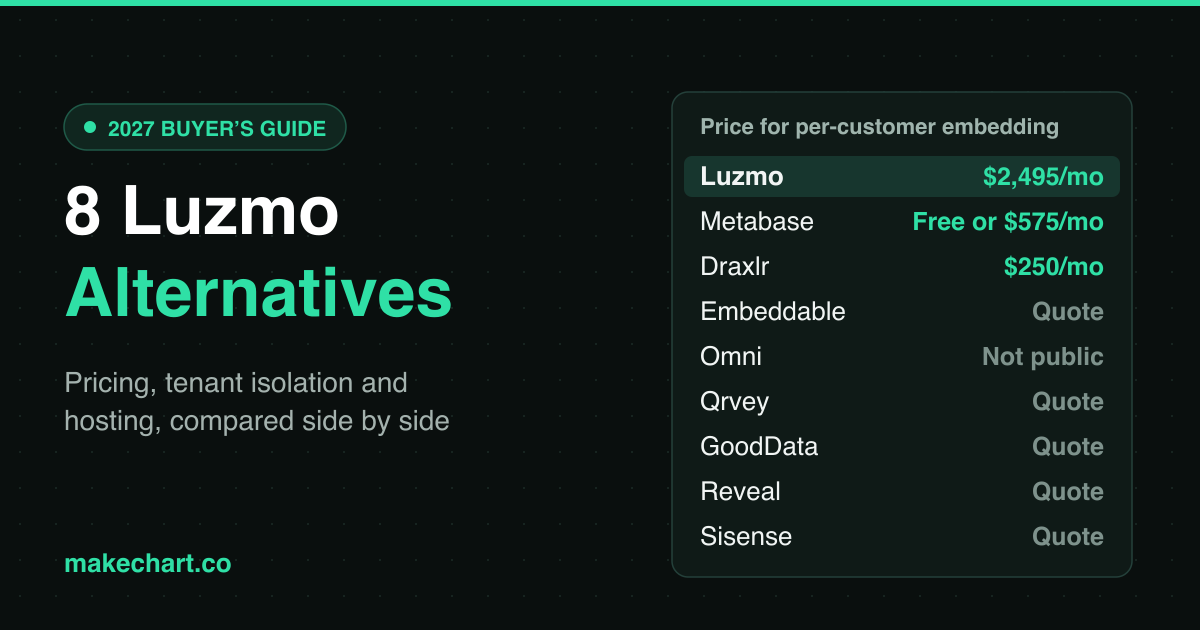
If you're comparing Luzmo alternatives, start with what changed in 2026. Luzmo, formerly Cumul.io, now sells one plan called Embedded Everywhere, and its pricing page says "there is no smaller tier" (Luzmo pricing). The list price is $2,495 or €1,995 a month, billed annually. As recently as July 2026, PricingSaaS logged a Starter plan moving from $495 to $995 (Luzmo pricing history).
This guide covers eight alternatives, what one workload costs, and what happens when a tenant filter goes missing. We've shown our work, including what we couldn't verify. For Power BI, Tableau or Looker, see our embedded analytics tools comparison.
Key Takeaways
- Luzmo starts at $2,495 a month billed annually, plus usage (Luzmo pricing page, November 2026).
- Only Metabase and Draxlr publish a price for per-customer embedding.
- Vendor docs describe very different behavior when a tenant value is missing or empty, and you should test that yourself before signing with any of them.
- We found no documented Luzmo importer.
Jump to: comparison table, workload cost, tenant isolation, migration.
Luzmo Alternatives for 2027 at a Glance
Prices are as published on November 9, 2026. The order isn't a quality ranking. Tools with a public price for per-customer embedding come first, cheapest first. That rule puts Draxlr second; ranked by mentions in the ranking guides, like the tools below it, it would be last. Quote-only tools follow by mention count, with ties alphabetical.
| Tool | Best for | Public price | Hosting |
|---|---|---|---|
| Luzmo (baseline) | One all-in plan | $2,495/mo, billed annually, plus usage | Managed cloud |
| Metabase | A free start | Free, or Pro at $575/mo | Self-host or cloud |
| Draxlr | Published flat pricing on SQL data | $250/mo with per-customer data | Cloud; self-host on Enterprise |
| Embeddable | Developer-owned components | Quote | Cloud, US or EU |
| Omni | One model for BI and embeds | None published | Cloud |
| Qrvey | Running in your own cloud | Quote by email | Your AWS, Azure or GCP |
| GoodData | Many similar tenants | Quote | SaaS; self-host on Enterprise |
| Reveal | An SDK on your own servers | Quote | Self-hosted |
| Sisense | On-premises deployment | Quote | SaaS, your cloud or on-prem |
1. Metabase: Best Free Starting Point
Metabase is the only tool here with a free way to show each customer their own data. Guest embeds work on every plan, including open source, and those viewers aren't billed as users. You sign the customer's ID into the embed token as a locked parameter, and Metabase applies the filter before anything reaches the browser (Metabase guest embedding docs). The free route has limits, though. Open source and Starter embeds keep a "Powered by Metabase" banner, and guest embeds can't use row and column security, database routing, drill-through, the query builder or AI chat. Those need SSO-based embedding on Pro or Enterprise.
Pricing: Open source is free to self-host. Starter is $100 a month with 5 users. Pro is $575 a month with 10 users, then $12 per extra user, or $6,210 a year billed annually. Enterprise starts at $20,000 a year (Metabase pricing).
Watch out for: The React SDK and full app embedding are Pro or Enterprise only (Metabase full app docs). Embedding under the open-source license means keeping the logo or complying with the AGPL, a copyleft license (Metabase license). SSO-based embeds create a Metabase account for each viewer, and Metabase sells "tailored embedding packages" to companies with many end customers.
Best for: Early products with engineers who can host it and customers who only need to view dashboards.
2. Draxlr: Best for Published Flat Pricing on SQL Databases
Draxlr charges by databases and builder seats, and people viewing embeds don't count as users on any plan (Draxlr pricing). You set up an embed in a visual builder with a live preview, and the embed code updates as you change settings (Draxlr embed docs). There are two ways to embed: a single dashboard, or a full analytics workspace for each customer (Draxlr full app docs).
What it does well:
- Unlimited viewers on every plan. Customers who view embeds never count as seats.
- Visual embed setup. Set allowed domains, show or hide the header, change the background color and preview desktop and mobile layouts. Then copy the finished snippet for HTML, React or Vue.
- Control over what viewers can do. Turn CSV export on or off, configure drill-down for each dashboard element, and pre-set or hide filters.
- Row-level security (RLS) across the whole embed. Rules apply to "every dashboard element, filter, drill down and export," and you can preview a dashboard as a specific customer before it goes live (Draxlr embed docs).
- Self-serve analytics with full app embedding. Customers get the dashboards you share, filtered to their own data, plus their own dashboards, saved queries in folders, a no-code query builder, a SQL editor and an AI assistant that answers plain-English questions with tables and charts (Draxlr full app docs).
- A choice of what customers can use. You can offer only the AI assistant, for example, or turn off dashboard creation.
- A separate workspace for each customer. It shows only the database you pick, the dashboards you share and that customer's own work, never your team's queries or other customers' workspaces.
- Three ways to build: AI, a no-code query builder or raw SQL.
- White-label embeds. Every plan with embedding removes Draxlr's branding and lets you match your brand colors.
- Live queries on 14 SQL databases and warehouses, including PostgreSQL, MySQL, Snowflake, BigQuery and ClickHouse, without storing your database data.
- Alerts and reports. Slack and email alerts, scheduled dashboard reports, and PDF or Excel exports.
Pricing: Premium is $75 a month (2 databases, 10 users) and includes white-label embeds, but it has no enforced per-customer isolation. Power is $250 a month, or $2,000 a year billed annually (Draxlr vs Qrvey), with 5 databases, 30 users and 300 AI credits a month. It's the first plan with RLS and full app embedding, and customers' AI questions in the full app draw on your credits at one credit per message. Another 200 credits cost $10 a month. Enterprise starts at $500 a month through sales and adds SSO, audit logs and self-hosting.
Watch out for: It connects to SQL databases and warehouses, plus Airtable and file uploads, with no native MongoDB connector or plugin API (Draxlr vs Luzmo). There's no central layer of metric definitions, since Draxlr queries your tables directly. Results are cached, though caching is configurable.
Best for: SaaS teams on PostgreSQL, MySQL or a warehouse, with customer data in shared tables. Draxlr's embedded analytics page has the plan details.
3. Embeddable: Best for Developer-Owned Components
Embeddable renders inside your page through a web component, with no iframe to style around (Embeddable embedding docs).
You pass security filters through the Tokens API, and if a filter can't be applied, "the query fails" (Embeddable row-level security docs). Customers with their own database can be routed through separate environments.
Pricing: A "flat monthly subscription" based on project scope, with "No usage-based pricing" (Embeddable pricing). You'll have to ask for the number.
Watch out for: Self-hosting "is not a standard option," and Embeddable's own comparison says "engineers own it, so it suits teams with developer time to give it." The AI chatbot uses your own LLM key and is still labeled Prototype in the docs.
Best for: Product teams whose front-end engineers want analytics inside their own codebase.
4. Omni: Best for One Model Across BI and Embeds
Omni bought Explo in October 2025 and intends to migrate most Explo customers to its platform (Omni's Explo FAQ). It's also an internal BI tool, which lets one data model serve your team and your customers. Embeds are URLs signed on your server with each user's attributes inside them, and row-level permissions then show people reports "filtered to only their own data" (Omni embed docs).
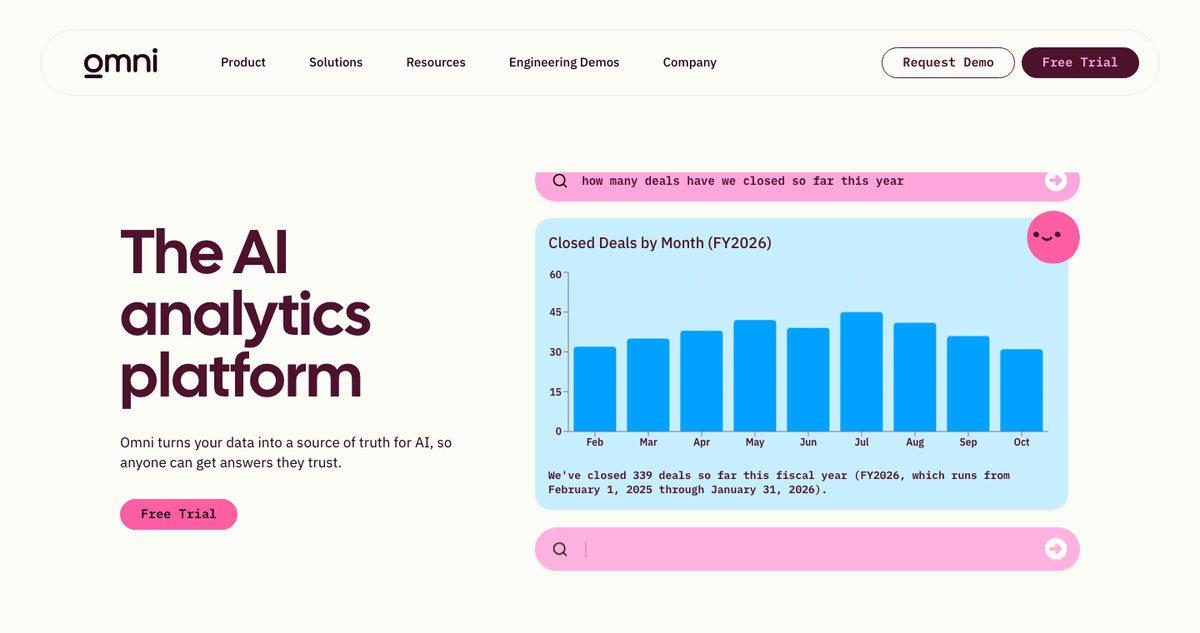
Pricing: We couldn't find a public price or a pricing page. AI usage past your allotment bills at $1.00 per credit (Omni AI usage docs).
Watch out for: Omni's own roundup says it "requires a warehouse and a real data model," and that's the main thing to weigh. Still on Explo? Omni's FAQ says "next 12 months" and gives no dates, even though the deal was announced on October 22, 2025. Get your sunset date in writing.
Best for: Warehouse-first companies with someone to own the data model.
5. Qrvey: Best for Running in Your Own Cloud
Qrvey deploys as Kubernetes containers in your own AWS, Azure or GCP account, single-tenant inside your virtual private cloud (Qrvey).
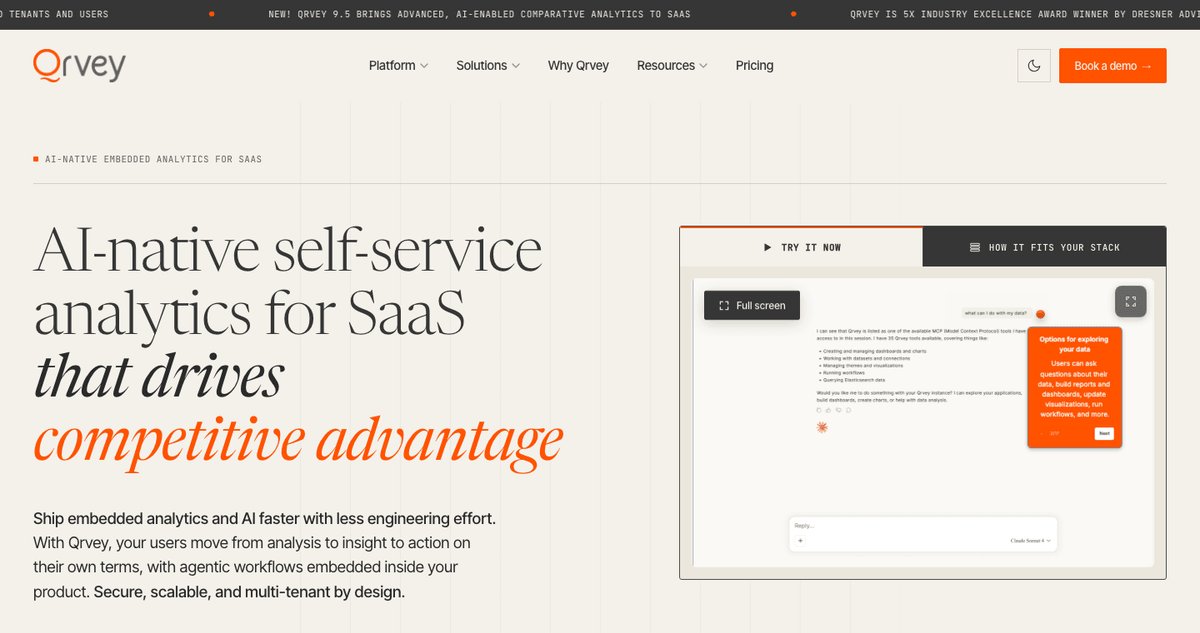
Pricing: Qrvey promises "Unlimited tenants, users, and dashboards under a single flat rate" and emails the price after a form. A one-time perpetual license is also available (Qrvey pricing). Vendr reports a $63,750 median and a $55,000 to $105,750 range, with no sample size given (Vendr).
Watch out for: In Live Connect, the mode that queries your database directly, "Joins, Unions, and Formulas are not supported" (Qrvey dataset docs). Managed datasets copy data into Qrvey's Elasticsearch store instead, and they're only available on the Ultra plan. We found no vendor-hosted option, which leaves you running Kubernetes.
Best for: SaaS companies with platform engineers and strict data-residency rules.
6. GoodData: Best for Many Similar Tenants
GoodData models customers as a workspace hierarchy. A parent workspace shares its content read-only with child workspaces, and data filters limit what each child sees (GoodData hierarchy docs). You can embed with iframes, Web Components or a React SDK (GoodData embed docs).
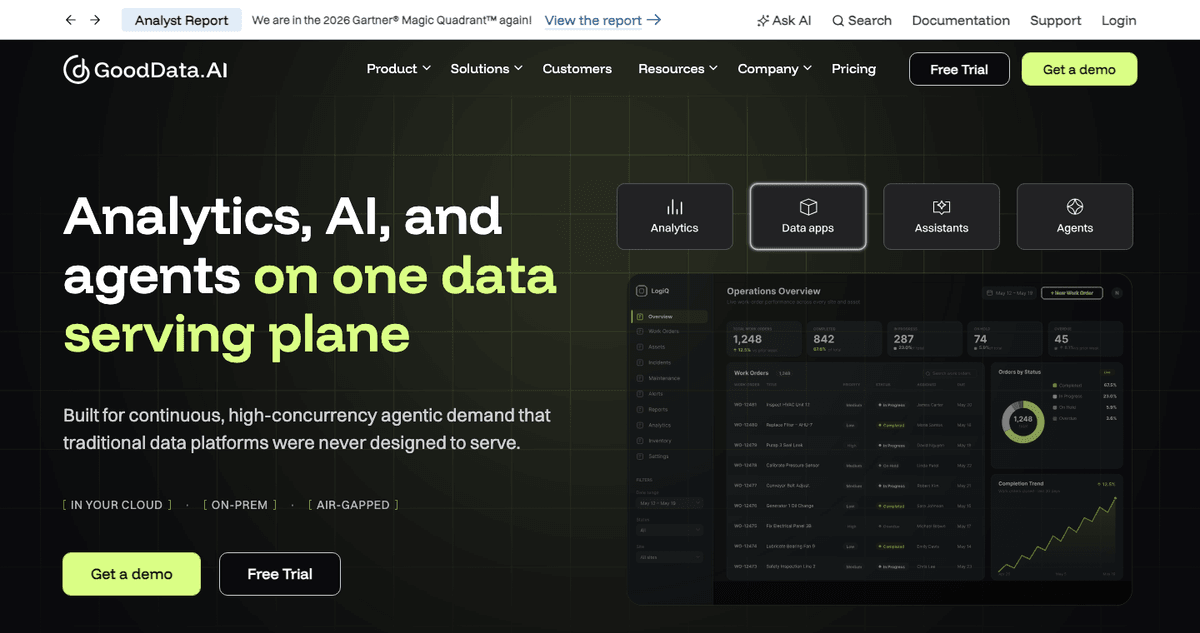
Pricing: The Professional plan is a platform fee plus a charge per workspace, with unlimited users and data (GoodData pricing). There's no public figure. Vendr reports a $223,000 median and a range of $65,310 to $243,887, but it shows no sample size and its page title still says 2025 (Vendr).
Watch out for: Plans are annual, and GoodData says "it's impossible to downgrade" before the term ends. If every customer gets a workspace, your bill follows your customer count. AI defaults to 30 queries per user per day under its fair usage policy.
Best for: Larger software companies with a data team and hundreds of customers on the same model.
7. Reveal: Best for an SDK on Your Own Servers
Reveal is an SDK, not a hosted service. A web component runs in your front end, a server SDK for .NET, Java or Node.js runs in your backend (Reveal docs), and Infragistics, the company behind it, says Reveal "supports fully self-hosted deployments" (Reveal security). It reaches SQL databases, MongoDB, Elasticsearch, REST APIs and spreadsheets (Reveal data sources). For tenant separation, a row filter set in the data source provider "is applied to every query that reads the data source item" (Reveal user context docs), and AI can be configured per tenant with your own LLM endpoints.
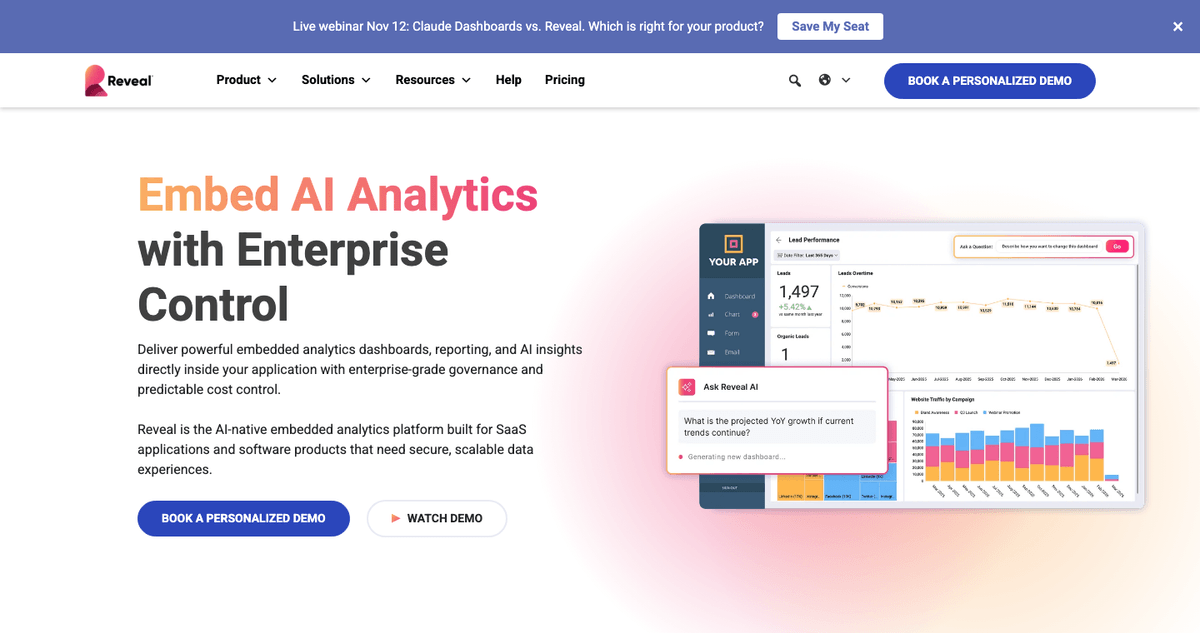
Pricing: A flat rate with unlimited users, quoted through a form (Reveal pricing).
Watch out for: The cache updates "once a day" by default, and you can change that to always, hourly or weekly (Reveal caching docs). Built-in row-level security covers a listed set of data sources, not every connector.
Best for: Teams on .NET, Java or Node.js who want analytics running on their own infrastructure.
8. Sisense: Best for On-Premises Deployment
Sisense deploys on SaaS, in your own cloud or on-premises (Sisense plans), and it documents several OEM architectures for software vendors. Its Compose SDK supports TypeScript, React, Angular and Vue. With "200+ connectors," it can query warehouse tables live or cache data in ElastiCube, its own analytical database (Sisense connectivity). Structured web access tokens can enforce row-level security through an acl claim (Sisense SDK security docs).
Pricing: Sisense doesn't publish prices. Vendr's data from 127 purchases shows a $57,000 median and a range of $18,367 to $178,681, last updated February 2026 (Vendr).
Watch out for: Multitenancy is a "premium feature," and it's worth confirming that your quote includes it (Sisense docs). Sisense also warns that "Most modern browsers block third-party cookies," which affects cookie-based SSO embeds.
Best for: Enterprises that need on-premises deployment and can sign a sales-led contract.
Which Other Luzmo Competitors Are Worth a Look?
Three smaller tools came up in our research, and each has a catch that's easy to miss.
- DataBrain lists plans from $39 to $3,125 a month, but "Embedded analytics is on Enterprise," which is quoted per instance (DataBrain pricing).
- Knowi handles MongoDB, Elasticsearch and REST APIs natively (Knowi data sources). Per-user SSO embedding is a paid add-on on every plan, Enterprise included (Knowi plans).
- QueryPanel publishes per-tenant pricing, with paid plans from $49 a month (QueryPanel).
QueryPanel's tenant isolation docs describe enforcement at SQL generation time, so ask how isolation holds when queries run.
Power BI, Tableau, Looker, Domo and ThoughtSpot are in our embedded analytics tools comparison.
Why Do Teams Look for a Luzmo Alternative?
Price and deployment are the two pressures we can document. We can't tell you how many customers actually leave, or why: none of the nine ranking guides we read quotes a former Luzmo customer.
Luzmo Pricing in 2026
Luzmo's list price puts the US floor at $29,940 a year before usage. Luzmo's Metabase comparison logged the USD update on September 24, 2026. PricingSaaS, a pricing tracker, recorded the all-in plan's earlier price as $1,995 and still lists three plans in its November 9 capture, including a $995 Starter. Luzmo's own page shows one plan, and we've gone with that. The plan includes 500 AI conversations and 100 million rows of Warp, Luzmo's data acceleration layer, each month. Extra Warp volume costs $0.25 per million rows, the AI overage rate is set in your contract, and some contracts scale on monthly active users instead (Luzmo pricing). Spread 500 conversations across 200 customer accounts and each one gets 2.5 a month.
Where Luzmo Runs
Luzmo offers multi-tenant cloud in the EU or US, plus dedicated cloud on AWS, Azure or GCP (Luzmo Trust Center). Its own comparison calls managed cloud "the public offer" (Luzmo vs Omni). For private infrastructure, Luzmo says "we adapt the deployment to your environment" and gives no public price (Luzmo pricing). We found no documented self-hosted install.
What Does One Workload Cost Across These Tools?
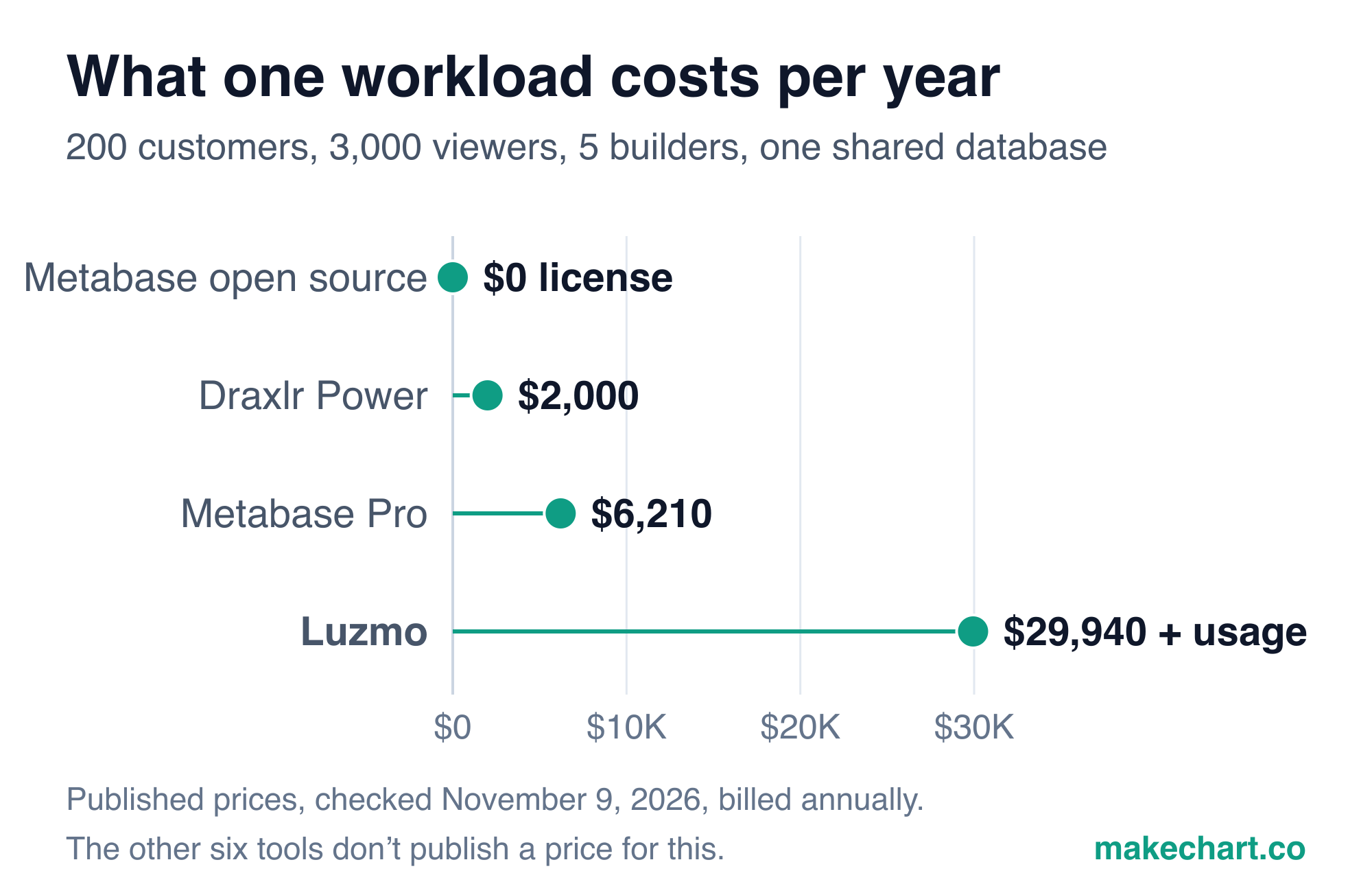
Only three products can be priced from public numbers for a workload of 200 customer accounts, 3,000 monthly viewers and five dashboard builders on one shared database: Draxlr at $2,000 a year, Metabase Pro at $6,210 and Luzmo from $29,940 before usage. Metabase's open-source edition is free if you host it and keep the banner. None of the ranking guides runs a single workload across its shortlist.
| Tool | Per year | Basis |
|---|---|---|
| Metabase open source | $0 license | Guest embeds, banner stays, you host it |
| Draxlr Power | $2,000 | Billed annually; $3,000 if paid monthly |
| Metabase Pro | $6,210 | Guest embeds only, billed annually |
| Luzmo | $29,940+ | $2,495 × 12, before usage |
| Embeddable, Omni, Qrvey, GoodData, Reveal, Sisense | Not public | Ask for a quote on this workload |
What the math shows: On Metabase, how viewers log in moves the total more than the plan does. Put those 3,000 viewers on SSO accounts and, with five builders, you have 3,005 users. At the listed annual rate of $130 each, the 2,995 above Pro's 10 included add $389,350. Metabase offers tailored packages at that scale, which makes this a list-price ceiling and not a likely bill. Ask every vendor who counts as a billable user.
This workload flatters Draxlr, and you should read it that way. One shared database and five builders is close to its best case. Power excludes SSO and audit logs, tops out at 5 databases and 50 connections, and a database-per-customer version of this workload rules it out. On the arithmetic we applied to Luzmo, Power's 300 AI credits come to 1.5 messages per account each month.
What Buyers Report Paying
Vendr publishes what its buyers paid. These are whole-contract medians for unknown deployment sizes, and they aren't comparable with the workload above.
| Tool | Median per year | Range | Sample |
|---|---|---|---|
| Metabase | $39,000 | $30,000 to $106,800 | Not stated |
| Sisense | $57,000 | $18,367 to $178,681 | 127 purchases |
| Qrvey | $63,750 | $55,000 to $105,750 | Not stated |
| Luzmo | $63,900 | Not stated | Not stated |
| GoodData | $223,000 | $65,310 to $243,887 | Not stated |
The Luzmo figure (Vendr) carries no date and may predate the one-plan model. Cledara reports a $15,000 average for the same product, less than a quarter of Vendr's number, which shows how thin this data is. The Metabase figure comes from Vendr too.
What Happens When the Tenant Filter Is Missing?
It depends on the tool, and on which value is missing. Metabase says that if you leave out a locked parameter, it "refuses the request" (Metabase parameter docs), and GoodData returns "a 400 status code error" when no value can be resolved (GoodData data filter docs). Knowi's docs say "A token with no contentFilters shows unfiltered data" (Knowi embed docs), and a Draxlr embed with no RLS group shows every row, while a group with no value shows no data. The table maps Luzmo's mechanism to each alternative.
| Tool | How tenants are separated | What the docs we read say about a missing value |
|---|---|---|
| Luzmo | parameter_overrides in the embed token; account_overrides for per-tenant databases | Not stated. An override replaces the filter's default value. Luzmo advises dataset-level filters so users can't remove them |
| Metabase | Locked parameter signed into the token | Omitted parameter: request refused. Passing [] turns the filter off |
| Draxlr | RLS group and attributes sent from your backend | No RLS group: every row shows, and full app users get the whole database. With a group, a missing attribute uses the group's value. No value at all returns no rows (Draxlr docs) |
| Embeddable | Security filters in the Tokens API | A passed filter that can't apply fails the query. No value sent: not found |
| Omni | User attributes signed into the URL | Not found |
| Qrvey | Record-level security through tokens | Not found |
| GoodData | Workspace data filters | 400 error if no value resolves. Otherwise a child inherits a parent's value |
| Reveal | Row filter in the data source provider | Not found |
| Sisense | Multitenancy, or an acl claim in the token | Not found |
These entries aren't like for like: a runtime error, an admin setting and an inheritance rule are different things. GoodData's owner workspace, for example, isn't filtered at all. "Not found" only means the docs we read were silent (Luzmo multi-tenant docs, Qrvey security docs).
Run this test during any trial. Request an embed with no tenant value, one with an empty value, and one carrying another customer's ID, then confirm that none returns the wrong rows. Check a filter that isn't connected to any chart as well: Metabase warns that such an embed "renders fine" while filtering nothing. Repeat all of it for exports, drill-through and AI questions. Metabase offers a 14-day trial on paid plans, Draxlr and Sisense offer 7 days, and Luzmo offers a free trial too.
When Does Staying on Luzmo Make Sense?
Leaving isn't always the right call. Luzmo says "Nothing is reserved for a higher plan," which puts white-label, self-service and AI in the base price. If usage spikes, it promises "no retroactive back-billing, no re-tiering, no renegotiation before renewal" (Luzmo pricing).
If price is your only objection, try negotiating first. Rebuilding dashboards costs money too.
How Hard Is It to Move Off Luzmo?
Plan on rebuilding. We found no documented Luzmo importer at any of these eight tools, and no public source gives a measured migration time, so we won't invent one. Luzmo's guidance for teams moving the other way, from Metabase, is blunt: "recreate dashboards. definitions do not port" (Luzmo vs Metabase).
- Time it to renewal. Luzmo's public price is billed annually, which means your contract sets your exit date.
- List what customers actually open. Rank dashboards by views and retire the long tail.
- Map your tenant logic. Every
parameter_overridesvalue in your token call needs a home in the new tool. Usingaccount_overridesfor per-tenant databases? Confirm routing support first, since Metabase only offers database routing on Pro and Enterprise. - Rebuild the top dashboards. Pick the right chart for each metric, and mock up replacements in the free MakeChart chart generator.
- Re-run the isolation test on the new tool with real tenant data.
- Check everything that isn't a dashboard. That means scheduled reports, exports and AI features.
How Do You Choose a Luzmo Alternative?
Answer four questions, in this order.
Where must it run? For your own network, look at Qrvey, Reveal, Metabase or Sisense. GoodData and Draxlr offer self-hosting on Enterprise.
Who pays when viewers grow? Draxlr, Embeddable, Qrvey and Reveal don't charge per viewer. Neither do Metabase's guest embeds, or GoodData, which bills per workspace. Metabase's SSO embeds and some Luzmo contracts can scale with users.
Who builds the dashboards? Embeddable and Sisense's Compose SDK expect developers writing code. Draxlr and Metabase include visual query builders and SQL editors.
Do customers view, or author? If they build their own reports, check that the feature is on the plan you're pricing. Draxlr's needs Power, and Metabase's query builder needs SSO on Pro.
The Short Version
Pick from these Luzmo alternatives by your main constraint: Metabase if budget rules, and Qrvey, Reveal or Sisense if you have to self-host. Embeddable fits teams that want the code. Draxlr fits SQL-based SaaS products that want a published flat price. Whichever you shortlist, run the missing-tenant test and ask who counts as a billable user.
Frequently Asked Questions
What is the best alternative to Luzmo?
It depends on your constraints. Based on vendor docs checked in November 2026, Draxlr suits SQL-based SaaS products that want published flat pricing, Metabase is the cheapest start, Qrvey fits teams that must run in their own cloud, and Embeddable suits developers who want code ownership.
How much does Luzmo cost?
Luzmo's pricing page lists one plan, Embedded Everywhere, at $2,495 or €1,995 a month billed annually. It includes 500 AI conversations and 100 million Warp rows a month. Usage above that costs extra, and some contracts scale on monthly active users instead. In US dollars, that makes the floor $29,940 a year.
Is there a free alternative to Luzmo?
Metabase's open-source edition is the closest free option. According to Metabase's embedding docs, guest embeds work on every plan and can filter by customer through a signed, locked parameter. The "Powered by Metabase" banner stays, you host it yourself, and features like drill-through need a paid plan.
Which Luzmo alternatives can be self-hosted?
According to their own docs, Metabase, Reveal, Qrvey and Sisense can all run on your infrastructure. GoodData offers self-hosting on Enterprise, and Draxlr lists it on its $500-a-month Enterprise plan. Embeddable says self-hosting is not a standard option. Luzmo's public offer is managed cloud, with dedicated deployments available.
Can I import Luzmo dashboards into another tool?
We found no documented Luzmo importer at any of the eight tools reviewed here, checked in November 2026. Plan to rebuild your most-used dashboards and re-create tenant filters. Luzmo's own guidance for teams moving the other way, from Metabase, says the same: recreate dashboards, because definitions don't port.
What happened to Explo?
Omni announced its acquisition of Explo on October 22, 2025, and said Explo customers would keep full access for 12 months while they migrate. Omni's Explo page gives no specific sunset date. If you're still on Explo, ask your account contact for the date that applies to your contract.